Joint Glide Ingredients: What's in the Current Formula?
The formula combines botanical extracts, MSM, glucosamine hydrochloride and micronutrients. The important question is not just whether an ingredient has ever been studied, but how directly that research applies to this formula and dose.
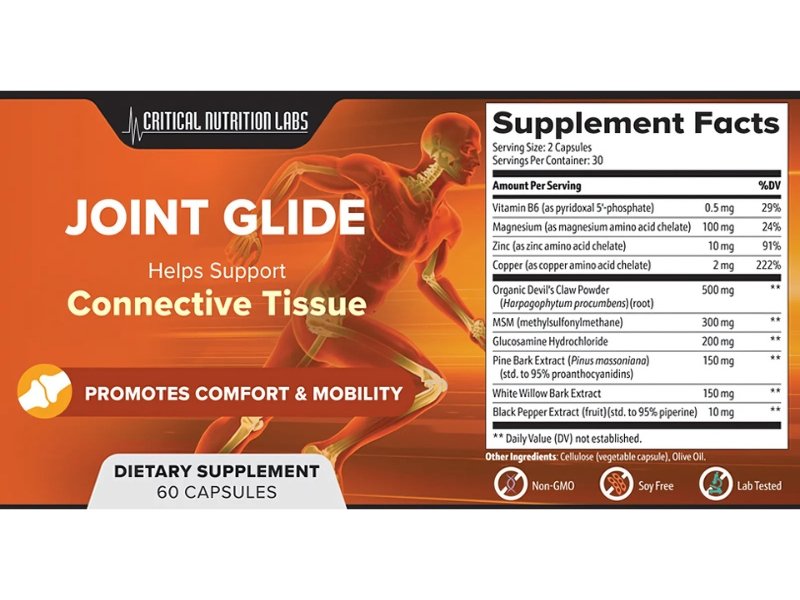
Current formula
| Ingredient | Amount per serving | Evidence context |
|---|---|---|
| Devil's Claw powder | 500 mg | Human research exists; not product-level proof |
| MSM | 300 mg | Limited/promising; studied doses may differ |
| Glucosamine Hydrochloride | 200 mg | Mixed evidence; formulation matters |
| Pine Bark Extract | 150 mg | Preparation-specific evidence |
| White Willow Bark Extract | 150 mg | Some pain-related evidence; safety matters |
| Magnesium | 100 mg | Nutritional role does not prove joint efficacy |
| Zinc | 10 mg | Nutritional role does not prove joint efficacy |
| Black Pepper Extract | 10 mg | Bioavailability mechanism; interaction potential |
| Copper | 2 mg | Nutritional role does not prove joint efficacy |
The supplied label also contains vitamin B6; the label remains the reference where manufacturer text listings are incomplete.
Devil's Claw
Devil's Claw has been investigated in human research involving osteoarthritis and musculoskeletal discomfort. That creates ingredient-level relevance, not proof that Joint Glide itself produces the same outcome. Source: peer-reviewed review of Devil's Claw research.
MSM
Randomized studies have evaluated MSM, but some used amounts measured in grams per day. Joint Glide provides 300 mg per serving, so a positive MSM study should not be described as proof of an equivalent research dose here. Source: systematic review of MSM and DMSO for osteoarthritis.
Glucosamine Hydrochloride
Glucosamine research is mixed and studies use different forms. Joint Glide contains glucosamine hydrochloride, so findings from glucosamine sulfate should not automatically be transferred to it. Source: NCCIH overview of glucosamine and chondroitin evidence.
Pine bark, white willow and piperine
Some standardized pine-bark preparations have supportive human studies, but extract equivalence must be established before transferring those results. White willow has pain-related research and salicylate-related safety considerations. Piperine can affect drug-metabolizing enzymes and transporters. Source: randomized trial of a specific standardized pine-bark preparation. NCCIH willow bark overview. peer-reviewed piperine interaction review.
See the product-level evidence analysis or review safety considerations.